
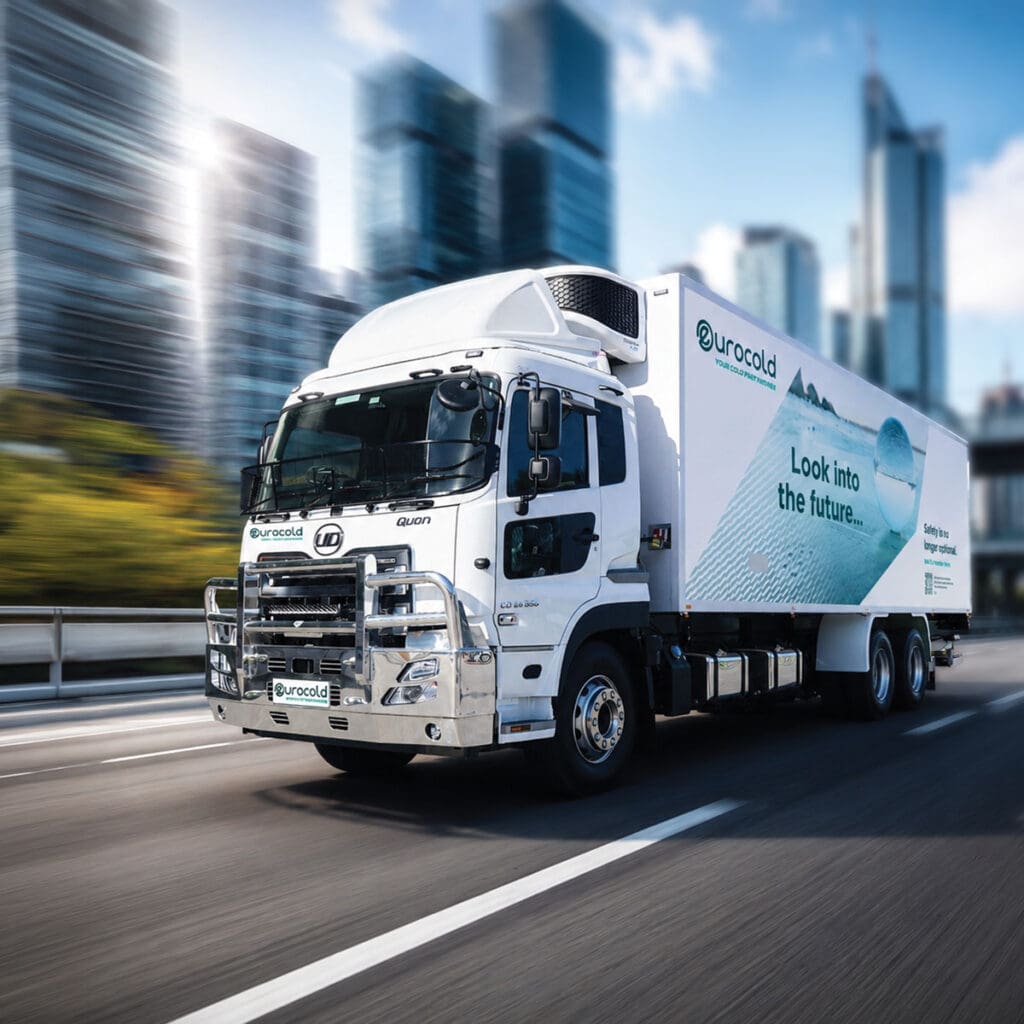
Electric refrigerated trucks are not a future concept. They are on Australian roads now, and the question most fleet operators are asking has shifted from “if” to “when”.
This article explains how EV refrigerated technology actually works: the refrigeration unit, the power source, the range considerations. It also looks at what Revora, our R&D and innovation arm, is building for Australian cold chain conditions specifically.
How do electric refrigerated trucks actually work?
The principle is the same as a diesel refrigerated truck. You have a chassis, an insulated body, and a refrigeration unit that maintains the cold chain at chilled (+2°C to +8°C) or frozen (down to −18°C) temperatures. What changes is the power source.
In a diesel rig, both the truck and the refrigeration unit draw on diesel. In an EV refrigerated truck, both run on the same high-voltage battery system. The refrigeration compressor is electrically driven, the truck is electrically driven, and there is no diesel auxiliary engine running the fridge while the truck is parked.
That single design choice changes a lot about how the vehicle operates day to day:
- Quieter operation, particularly during early-morning and late-night runs where noise restrictions apply
- Zero tailpipe emissions, which matters for low-emission zones and sustainability reporting
- Fewer mechanical moving parts in the powertrain, which typically reduces servicing complexity
- Different fuelling pattern, with charging windows replacing daily diesel stops
What about range and refrigeration runtime?
This is the question every fleet operator asks first, and rightly so. The honest answer is that range depends on three things working together: the size of the battery, the load on the refrigeration unit, and the duty cycle of the truck.
A 2-pallet refrigerated van running short urban delivery cycles will manage a full day comfortably. A larger 8-pallet refrigerated truck on a higher-energy duty cycle requires more careful route planning around charging infrastructure. The key is matching the EV to the route, not asking it to replicate a diesel’s behaviour identically.
The well-engineered EV refrigerated truck is one that has been sized properly for its run, with the refrigeration unit’s power draw factored into the range calculation from the start. That is where vehicle-level engineering, rather than off-the-shelf conversion, matters.
What is Revora, and what is it building?
Revora is our R&D, integration, and consulting entity. The simplest way to describe the relationship between Revora and Eurocold: Revora creates. Eurocold delivers.
Revora’s brief is the future of refrigerated transport across three horizons: net zero today, automation by 2030, and longer-term innovation beyond. The work happening now is concentrated on the first horizon, and it is the part that affects fleet operators most directly in the next few years.
The current Revora EV range available through Eurocold includes:
- 2 Pallet Revora EV Vans, suited to urban delivery, food service, and pharmacy couriers
- 3 Pallet Revora EV Trucks, for small distributors and SME food service operators
- 8 Pallet Revora EV Trucks, for larger food service runs and regional routes
Each Revora EV is engineered specifically for cold chain duty rather than retrofitted from a general-purpose EV chassis. That distinction shapes the refrigeration unit choice, battery sizing, and integration with the insulated body. You can view the full Revora EV range and what is currently available to rent or buy.
Why Australian conditions matter
An EV refrigerated truck engineered for a European delivery route is not the same vehicle as one engineered for an Australian one. The ambient temperature range is wider, the regional distances are longer, and the charging infrastructure landscape is different.
Revora’s brief is to build for the conditions Australian fleets actually run in. That includes high summer ambients that push refrigeration units harder, longer regional legs between metro and outer-metro drops, and a charging network that varies significantly between states.
JD Transport, founded and led by Joe Joseph, was the first Eurocold partner to pilot an 8-pallet EV refrigerated truck in operational service. The pilot is part of how we test EV cold chain performance against real Australian routes, not laboratory conditions. Our broader work on net zero and the future of cold transport sits alongside this.
What this means for fleet operators thinking about transition
You do not have to flip an entire fleet at once. The most practical transition path for most operators is to introduce one EV refrigerated vehicle on a route that suits its capabilities, then expand from there as charging infrastructure and your own confidence build.
The right starting vehicle depends on your routes, your load profile, and your charging access. If you are considering where to begin, we are happy to walk through it with you. Call 1300 222 323 or email [email protected], and we will help you scope an EV trial that fits your operation.